

Meet your future Agentic Store management team
Previously, I shared why I believe the future of physical retail has shifted from building a Smart Store to building an Agentic Store of the future.

Wachirawuth "Kitti" Rattiwarakorn
Founder & Strategic Advisor, Korn Consultancy · · 8 min read
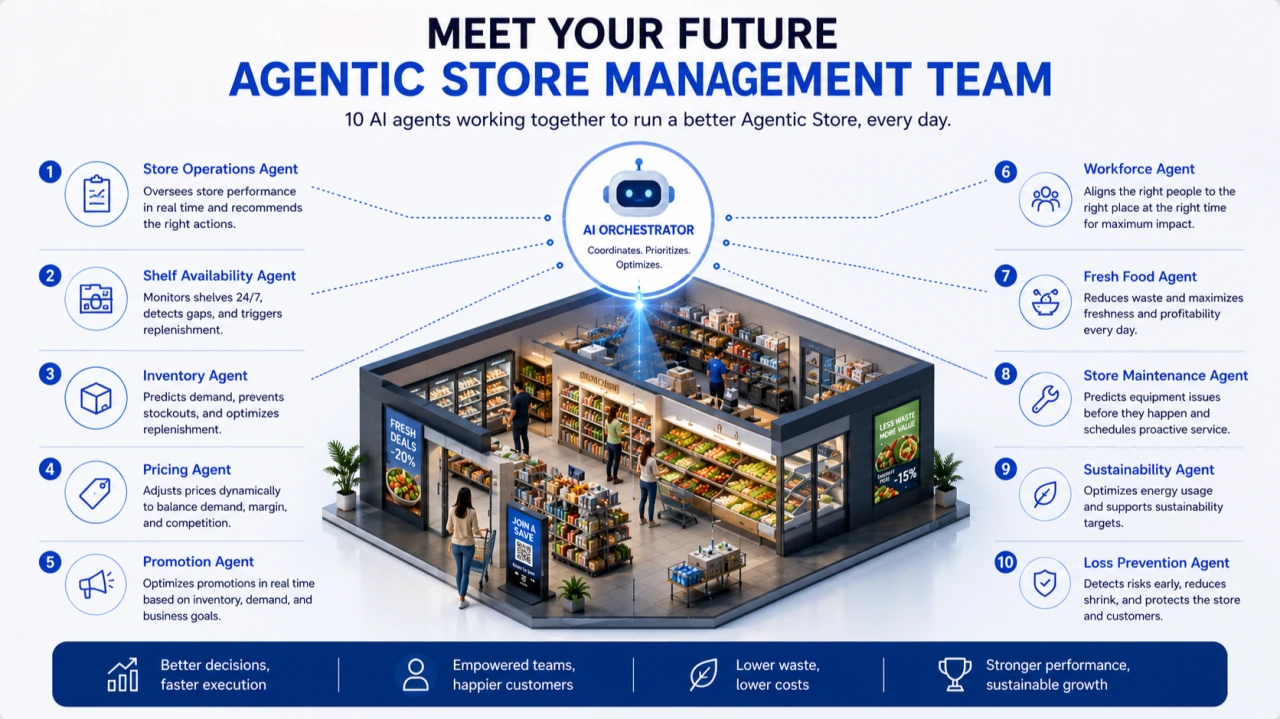
Previously, I shared why I believe the future of physical retail has shifted from building a Smart Store to building an Agentic Store of the future. You can read that piece here: A paradigm shift from smart store to agentic store.
Since then, one question keeps coming up: what exactly is an agentic store?
An agentic store isn't a store without people. It's a store where AI agents continuously sense operational events, coordinate the next best action, and free store managers and associates to focus on customers, judgment, and service.
Picture walking into your store tomorrow and finding you've hired ten new managers overnight. They don't sleep, they watch every part of the operation, they talk to each other, and they get sharper over time. Their whole job is making your team's job easier.
That's how I think about the agentic store. Not one super-intelligent AI, but a team of specialized agents, each responsible for a different part of store operations.
Meet your new Agentic Store team
Every successful store already has department managers with different responsibilities. The agentic store adds a layer of specialized AI agents that work the same way, behind the scenes. Here are the ten I believe will matter most.
1. Store Operations Agent
Retail's operational challenge isn't a lack of data; it's the cost of acting too slowly on it. IHL estimates that personnel-related issues contribute $291 billion to global inventory distortion, weak internal processes add another $239.1 billion, and poor data systems add $173.4 billion.
Think of this as the digital assistant to the store manager. It has a real-time view of everything happening in the store, from staffing levels and customer traffic to operational issues and daily priorities.
Instead of managers spending their day gathering information, the Store Operations Agent coordinates the business and flags where attention is needed most. It doesn't replace the manager. It helps the manager stay ahead of the business, turning real-time exceptions into prioritized tasks like "refill aisle 4," "check a delivery discrepancy," or "open another checkout," so managers spend less time coordinating and more time resolving.
2. Shelf Availability Agent
The global FMCG out-of-stock rate has long averaged about 8.3%, roughly 8 of every 100 items shoppers look for are unavailable. Stock-outs cost a typical retailer about 4% of sales; when an item is missing, 31% of shoppers buy it elsewhere and 9% abandon the purchase entirely.
One of retail's biggest frustrations is an empty shelf while inventory sits in the stockroom. This agent continuously monitors shelf conditions using computer vision, inventory data, and sales activity.
When it spots a gap, it doesn't just raise an alert. It creates a replenishment task, prioritizes it, and tracks completion; combining shelf signals, backroom inventory, and sales velocity to reach an associate before a shopper hits the empty shelf. Customers see full shelves. Associates spend less time searching for problems.
3. Inventory Agent
Inventory distortion remains a trillion-dollar retail problem. In 2023, IHL estimated global losses of $1.77 trillion: $1.2 trillion from out-of-stocks and $562 billion from overstocks, which often end in markdowns, write-offs, or spoilage.
Too much inventory ties up working capital. Too little disappoints customers. The Inventory Agent continuously predicts future demand, flags supply risks, recommends transfers between stores, and adjusts replenishment plans before shortages occur, reconciling POS, delivery, backroom, and shelf data, then weighing the risk of a lost sale against the cost of excess stock. Instead of reacting to yesterday's numbers, retailers start acting on tomorrow's demand.
4. Pricing Agent
Static, calendar-led markdowns often discount products too early or too deeply. In a case study of a large European discount retailer, machine-learning markdown optimization recommended prices around 20% higher than the actual markdown prices used for most items, cut unit sales by only about 6%, still met inventory-clearance targets, and increased clothing revenue by 10%.
Dynamic pricing has existed for years. What changes is the speed and intelligence behind each decision. The Pricing Agent weighs inventory, demand, competitor pricing, weather, local events, expiration dates, and profitability before recommending or executing price changes within predefined guardrails, protecting margin while giving customers timely, relevant offers. For retailers using electronic shelf labels, these changes can roll out across the store almost instantly.
5. Promotion Agent
Promotions are often mistaken for incremental growth. A Nielsen study cited by McKinsey found that 59% of promotions globally lost money; in the United States, the figure reached 72%.
Not every promotion should run exactly as planned, inventory can run lower than expected, or demand can already be exceeding forecasts. The Promotion Agent recommends delaying, adjusting, or redirecting campaigns based on live business conditions: forecasting true incremental lift, accounting for cannibalization and stock-up behaviour, checking whether promoted stock is actually available, and flagging changes before a campaign erodes margin. Marketing becomes adaptive rather than static.
6. Workforce Agent
Poor labour planning is already a revenue and retention problem. 77% of retail associates say their store regularly loses sales because of poor scheduling or staffing decisions, 51% say their store is short-staffed during busy periods most of the time, and only 36% say schedules consistently match actual store traffic.
Labour is one of the largest costs for any retailer. The Workforce Agent monitors customer traffic, checkout queues, online order volumes, and replenishment workloads throughout the day, translating footfall, queues, fulfillment workload, and task volume into live redeployment recommendations, supporting managers in the moment rather than just producing a weekly roster. It helps managers put associates where they create the most value, improving both productivity and customer experience.
7. Fresh Food Agent
Fresh retail fails in two directions: over-order and you get waste, under-order and you get empty shelves. US retail generated an estimated 3.98 million tons of surplus food in 2024, valued at $26.9 billion, with produce the largest category by tonnage. In a two-retailer trial, AI-enabled order optimization cut food waste by an average of 14.8% per store; scaled across grocery, the study estimated more than $2 billion in financial benefit.
The Fresh Food Agent monitors freshness, sales velocity, weather, local demand, and inventory levels, and recommends production adjustments, markdowns, transfers, or replenishment changes to cut waste while protecting profitability.
8. Store Maintenance Agent
Equipment failures can destroy inventory, disrupt trading, and pull associates away from customers. Grocery repair and maintenance costs rose 17.3% between 2022 and 2024, faster than direct store operating expenses, and 19% of work orders recurred within 30 days. Refrigeration alone typically accounts for 38–50% of a grocery store's energy use.
The Store Maintenance Agent reads sensor data from refrigeration units, HVAC systems, lighting, and other critical equipment to catch issues before they become costly disruptions: abnormal temperature, energy, or vibration patterns get flagged, work orders get prioritized, and products get protected before a failure turns into a spoilage event.
9. Sustainability Agent
Sustainability targets often stall at the store level because energy, refrigeration, lighting, waste, and equipment data sit in separate systems. A study covering more than 1,700 Japanese retail locations found that installing an AI energy-management system cut electricity consumption by an average of 1.9%.
The Sustainability Agent continuously tunes lighting, refrigeration, air conditioning, and other energy-intensive assets against operational requirements and customer comfort, translating IoT signals into actions like correcting refrigeration set points, catching energy anomalies, or rescheduling equipment operation, within food-safety and shopper-comfort guardrails. Sustainability becomes part of everyday decisions instead of an annual initiative.
10. Loss Prevention Agent
Shrink is both a financial and a frontline safety issue. The NRF retailer survey found the average number of shoplifting incidents in 2023 was 93% higher than in 2019, and dollar losses from shoplifting rose 90%. In one reported grocery deployment, AI vision at self-checkout cut self-checkout losses by 35%, a case-specific result, not a guaranteed one.
By combining transaction data, inventory movements, computer vision, and operational patterns, the Loss Prevention Agent flags unusual activity earlier, unscanned self-checkout items, abnormal refunds, receiving discrepancies, high-risk zones, while cutting down on unnecessary investigations and false alarms. Its job isn't simply to catch theft. It's to protect profitability without turning every store visit into a search for suspects.
The real transformation isn't individual agents
After reading this list, it's tempting to think the future is ten separate AI systems bolted onto a store. I don't think that's where the value is. The real shift happens when these agents work together.
Imagine a product suddenly goes viral on social media or there is a sudden event which triggers customers to panic buy:
- The Inventory Agent predicts a shortage.
- The Pricing Agent pauses planned discounts.
- The Promotion Agent shifts campaigns toward substitute products.
- The Workforce Agent assigns extra associates to replenishment.
Each agent solves a different problem. Together, they solve one business problem. That's the difference between Smart Store and an Agentic Store.
Retail has always been about people
Whenever AI enters the conversation, there's an understandable worry that technology will replace people. I see it differently. The best retailers have always run on great people, store managers, department managers, merchandisers, associates, customer service teams.
Agentic AI doesn't change that. It strips out repetitive coordination, admin work, and operational firefighting so people can do what only people can do: build relationships, solve complex problems, mentor teams, create the moments customers remember.
The future store won't win because it has the most AI. It will win because AI gives its people more time to be human.
Always glad to compare notes with anyone building this. If you're working on agentic retail, reach out; I'd like to hear what you're seeing.
Sources
- Food Institute: Why inventory distortion costs retailers trillions
- Pygmalios: State of Retail 2026
- Blue Yonder: Retail inventory distortion report
- IEEE Big Data 2021 proceedings
- AI Best Practices: Promotional lift forecasting
- Logile: Retail labor plans fall short on the front line
- Pacific Coast Collaborative: AI case study (PDF)
- ReFED: 2026 AI report (PDF)
- Vixxo: Refrigeration reliability as the frontline of brand trust
- Envigilance: Grocery refrigeration monitoring
- RePEc discussion paper
- NRF: Shoplifting incidents jump 93% since pre-COVID
- AI Best Practices: AI-driven shrinkage and theft detection
Share this article
This article reflects the author's views for general information only and is not professional advice. See our Disclaimer.
Related insights
Retail AI
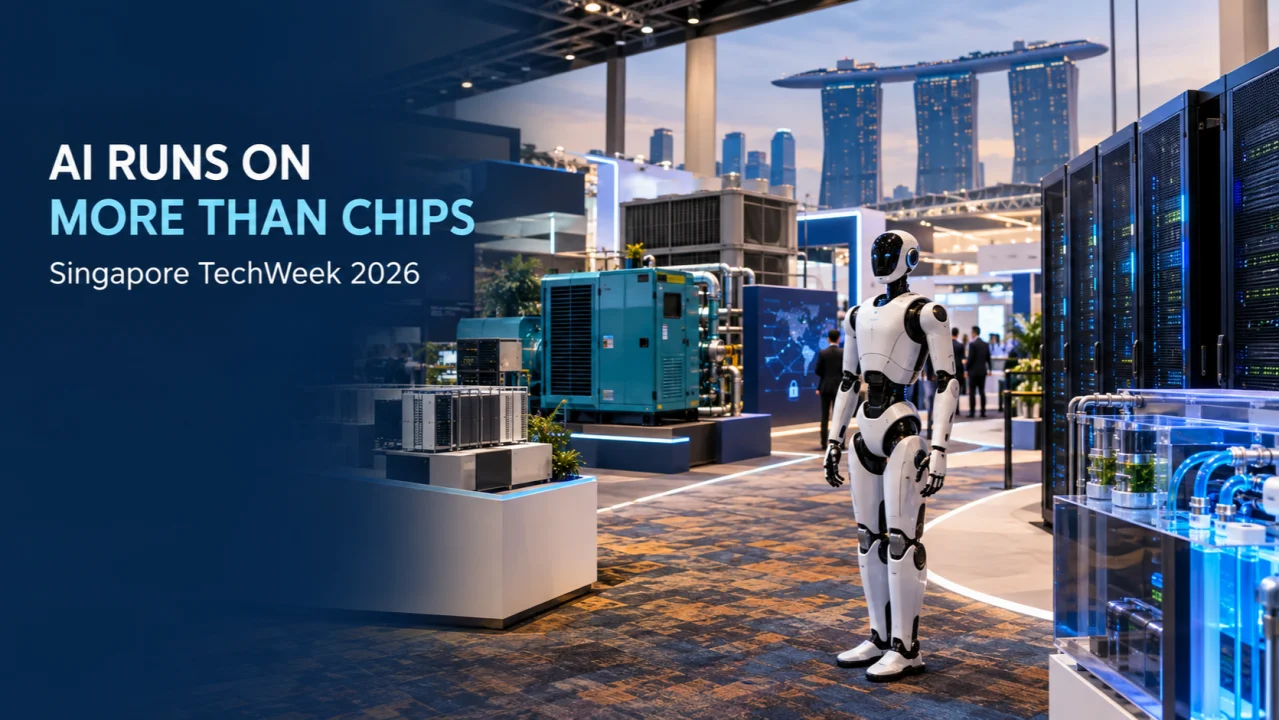
AI runs on more than chips: what stayed with me after Singapore TechWeek 2026
The image I keep thinking about from Singapore TechWeek is a humanoid robot on the exhibition floor, with generators, cooling equipment, and data-centre systems all around it.
1 October 2026 · 4 min read
Retail AI
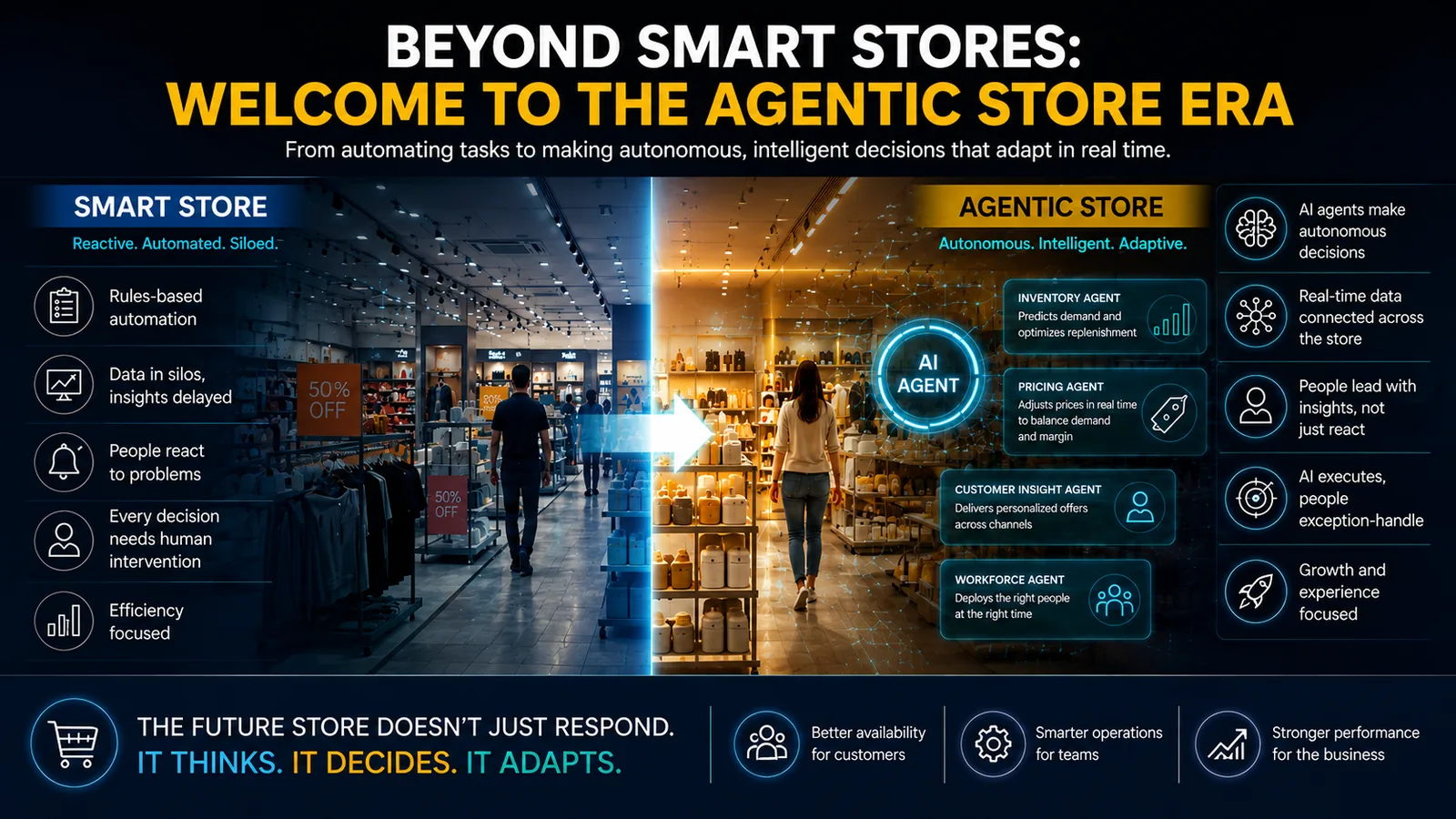
A paradigm shift from Smart Store to Agentic Store
For a decade, retailers poured billions into smart stores: sensors, cameras, electronic shelf labels, self-checkout, dashboards. Stores got smarter.…
11 August 2026 · 5 min read
Discuss this with Kitti
Book a confidential Executive Strategy Session to explore your goals, challenges and the most promising next steps.